Pasture-Raised Eggs: What the Label Actually Means
"Pasture-raised," "free-range," "cage-free," "organic" — four labels, four very different realities for the hen, and only one of them has an actual space requirement behind it. Here's what each one legally requires, what it doesn't, and how we actually do it in Alva, Florida.
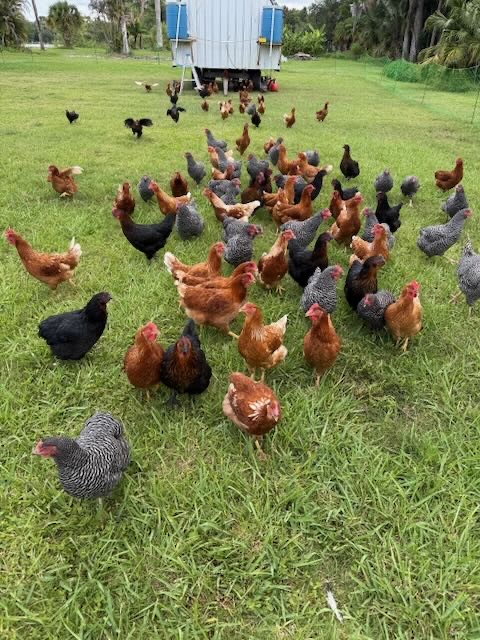
- "Pasture-raised" means hens get daily outdoor access to actual grass and dirt — not just a concrete pad they can technically reach.
- The industry benchmark, set by third-party certifiers, is 108 square feet of pasture per hen — about 54 times more space than the free-range standard under the same certification.
- There's no federal law defining "pasture-raised" for eggs sold outside the USDA's voluntary grading program — which covers most farm-direct eggs, ours included. That's exactly why it matters who you're buying from.
- Our hens move to fresh pasture every day and eat a non-GMO feed. We don't hold a third-party certification, and we'll tell you exactly why below.
What "pasture-raised" actually means
Here's the part most egg cartons don't tell you: the USDA does regulate the term "pasture raised" for meat and poultry — but shell eggs are a different animal, legally speaking. They fall under FDA jurisdiction, and the FDA has no standard for "pasture-raised" at all. So when you see it on a carton, you're reading a claim, not a certification.
In April 2025 the USDA's Agricultural Marketing Service tightened this a little: eggs carrying the official USDA grademark (the shield logo used in its voluntary grading program) can no longer say "pasture-raised" unless that claim is backed by a nationally recognized third-party certifier, like Certified Humane or American Humane Certified.
That's a real improvement — but it only applies to eggs sold under that voluntary USDA grading program. Most pasture-raised eggs sold direct from a farm, at a farm stand or farmers market, are never graded through it at all. Ours aren't. Which means the honest answer to "is this really pasture-raised?" almost always comes down to trusting the specific farm, not the word on the carton.
Cage-free vs. free-range vs. pasture-raised vs. organic
Every label answers a different question. None of them, alone, answers all of them.
Space figures for free-range and pasture-raised reflect the Certified Humane / American Humane Certified standards — the most commonly used third-party benchmarks, since neither term has its own federal space requirement.
Does the space actually change the egg?
Yes — and it comes down to what the hen eats, not just where she stands. A hen with real pasture access spends her day foraging: grass, bugs, worms, whatever she finds in the dirt. A hen on a uniform grain ration doesn't have that option.
The most academically rigorous comparison is a 2010 Penn State study (Karsten et al., Renewable Agriculture and Food Systems), which found eggs from pastured hens had roughly twice the vitamin E, twice the long-chain omega-3 fatty acids, more than double the total omega-3 content, and a healthier omega-6-to-omega-3 ratio compared to eggs from caged hens — plus 38% higher vitamin A concentration.
Those numbers track with the diet, not a marketing claim. It's also why yolk color alone isn't proof of anything — commercial feed can be dosed with marigold extract or paprika to darken a yolk regardless of how the hen actually lived. If yolk color is the only thing you're checking, you're not checking enough.
Five things people get wrong about these labels
It isn't. Cage-free only means the hen isn't in an individual wire cage — she can still be one of thousands packed into a single indoor barn with less than a square foot of space and zero outdoor access. Cage-free is a housing improvement over battery cages, not a welfare standard.
The USDA's free-range definition for eggs requires only "continuous access to the outdoors" — no minimum space, and the outdoor area can be a small fenced or netted pad. In large operations, many hens never actually reach the door.
Organic is a feed and chemical standard — no synthetic pesticides, no antibiotics — with outdoor access required but no minimum space specified. It says nothing about how much room a hen actually has to forage. A carton can be organic without being meaningfully pasture-raised, and vice versa.
Not as a standalone program. Outside the USDA's voluntary grademark process (which only covers grademarked cartons), a farm can put "pasture-raised" on eggs sold direct to consumers with no inspection or certification required at all. That's not a loophole we're hiding from — it's exactly why we think you should be able to ask us anything and come see it yourself.
This one runs backwards. Outdoor access means more contact with wild migratory birds, which are the primary carriers of Highly Pathogenic Avian Influenza (HPAI) — so pastured flocks carry a higher exposure risk, not a lower one. A healthier bird isn't a protected bird against a strain it's never met. Responsible pasture farms take biosecurity seriously precisely because of this, not in spite of it.
How we actually raise ours
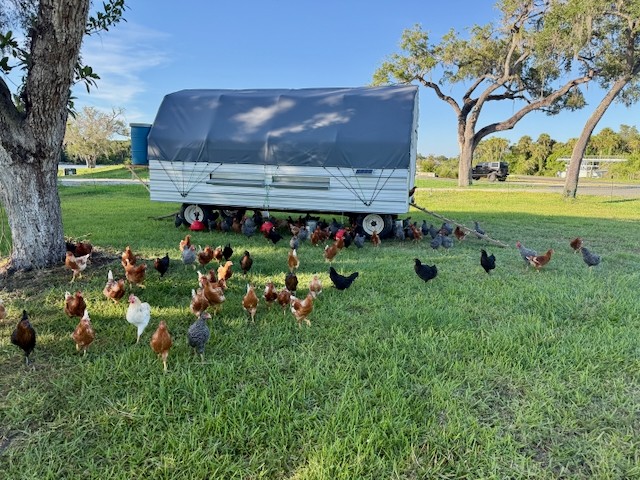
Our hens move to fresh pasture every day. They eat a non-GMO feed, plus whatever they find scratching around — grass, bugs, worms. Nothing here is graded through the USDA's voluntary program, so nothing on our cartons carries a shield or a certification seal. That's a choice, not an oversight.
Certification exists to build trust at a distance — it's how a national brand proves a claim to a customer who will never see the farm. We're a family operation in Alva, Florida, and everything we raise is sold within about 25 miles of here. Our version of that same trust is simpler: come see it yourself. Walk the pasture. Watch the hens. Ask us anything.
You can read more about how the whole farm runs — the birds, the pasture rotation, the family behind it — on our story page.
What to ask any farm selling "pasture-raised" eggs
Since the label alone can't tell you much, the questions do the real work. Ask us any of these — here's what we'd actually say.
No. We're small enough that a certification isn't how you'd verify us — a visit is.
They rotate onto fresh pasture daily — not a fixed pad they revisit.
Yes. That's the whole point of being a small, local operation.
A non-GMO feed, supplemented by whatever they forage on pasture.
About 25 miles or less — sold locally at Rooster's on Route 80, Alva.
Frequently asked questions
Not federally, for shell eggs. The USDA regulates "pasture raised" for meat and poultry, but eggs fall under the FDA, which has no standard for the term. Since April 2025, the USDA does require third-party certification for eggs carrying its own grademark that use the phrase — but that only covers eggs sold through its voluntary grading program, not most farm-direct eggs.
Peer-reviewed research (Karsten et al., Penn State, 2010) found meaningfully higher vitamin E, vitamin A, and omega-3 content in eggs from pastured hens compared to caged hens, driven by the hens' more varied, natural diet.
Mainly space and what "outdoor access" means. Free-range only requires continuous access to an outdoor area, which can be a small fenced pad. Pasture-raised (under the common third-party standard) requires 108 square feet of actual pasture per hen — about 54 times more space.
No. Organic is about feed and chemical inputs, not space. A carton can be certified organic without the hens having meaningful room to roam, and a pasture-raised farm doesn't automatically feed a certified organic diet. They're two different questions.
Fewer hens per acre, more land, more labor moving them daily, and none of the density that makes a caged operation cheap to run per egg. Buying direct from a farm (like a farm stand) usually narrows that gap compared to a retail markup.
No — outdoor access means more exposure to wild birds, the main carriers of HPAI, so the risk runs the other way. A responsible pasture farm takes biosecurity seriously rather than assuming outdoor birds are automatically safer.
Ask the farm directly: how much space, what certification (if any), and whether you can visit. A farm that can't or won't answer those plainly is telling you something.
Find our pasture-raised eggs
You'll find them exclusively at Rooster's on Route 80 in Alva.
Or get our weekly note — often with what's fresh and where to find it.
USDA Agricultural Marketing Service, Shell Egg Grading Q&A and QAD 709 Policy Update Memo (April 2025) · Certified Humane / Humane Farm Animal Care, pasture-raised and free-range standards · Karsten, H.D. et al., "Vitamins A, E and fatty acid composition of the eggs of caged hens and pastured hens," Renewable Agriculture and Food Systems (Penn State, 2010) · USDA APHIS, HPAI detections in wild birds and commercial/backyard flocks.